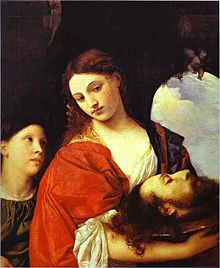
- And when a convenient day was come, that Herod on his birthday made a supper to his lords, high captains, and chief estates of Galilee; And when the daughter of the said Herodias came in, and danced, and pleased Herod and them that sat with him, the king said unto the damsel, Ask of me whatsoever thou wilt, and I will give it thee. And he sware unto her, Whatsoever thou shalt ask of me, I will give it thee, unto the half of my kingdom. And she went forth, and said unto her mother, What shall I ask? And she said, The head of John the Baptist.
- And she came in straightway with haste unto the king, and asked, saying, I will that thou give me by and by in a charger the head of John the Baptist. And the king was exceeding sorry; yet for his oath's sake, and for their sakes which sat with him, he would not reject her. And immediately the king sent an executioner, and commanded his head to be brought: and he went and beheaded him in the prison, and brought his head in a charger, and gave it to the damsel: and the damsel gave it to her mother. And when his disciples heard of it, they came and took up his corpse, and laid it in a tomb. (Mark 6:21-29, KJV)
A parallel passage to Mark 6:21-29 is in the Gospel of Matthew 14:6-11:
- But on Herod's birthday, the daughter of Herodias danced before them: and pleased Herod. Whereupon he promised with an oath, to give her whatsoever she would ask of him. But she being instructed before by her mother, said: Give me here in a dish the head of John the Baptist. And the king was struck sad: yet because of his oath, and for them that sat with him at table, he commanded it to be given. And he sent, and beheaded John in the prison.
- And his head was brought in a dish: and it was given to the damsel, and she brought it to her mother. And his disciples came and took the body, and buried it, and came and told Jesus. (Matt 14:6-11, D-R)
Some ancient Greek versions of Mark read "Herod's daughter Herodias" (rather than "daughter of the said Herodias").[1] To scholars using these ancient texts, both mother and daughter had the same name. However, the Latin Vulgate Bible translates the passage as it is above, and western Church Fathers therefore tended to refer to Salome as "Herodias's daughter" or just "the girl". Nevertheless, because she is otherwise unnamed in the Bible, the idea that both mother and daughter were named Herodias gained some currency in early modern Europe.[citation needed]
This Salome is not considered to be the same person as Salome the disciple, who is a witness to the Crucifixion of Jesus in Mark 15:40.
Salome (Greek: Σαλωμη, Salōmē), the Daughter of Herodias (c AD 14 - between 62 and 71), is known from the New Testament (Mark 6:17-29 and Matt 14:3-11, where, however, her name is not given). Another source from Antiquity, Flavius Josephus's Jewish Antiquities, gives her name and some detail about her family relations.
Her name in Hebrew is שלומית (Shlomiẗ, IPA: [ʃlomiθ]) and is derived from the root word ŠLM (שלם), meaning "peace".
Christian traditions depict her as an icon of dangerous female seductiveness, for instance depicting as erotic her dance mentioned in the New Testament (in some later transformations further iconised to the dance of the seven veils), or concentrate on her lighthearted and cold foolishness that, according to the gospels, led to John the Baptist's death.
A new ramification was added by Oscar Wilde, who in his play Salome portrayed her as something of a femme fatale. This last interpretation, made even more memorable by Richard Strauss's opera based on Wilde, is not consistent with Josephus's account; according to the Romanized Jewish historian, she lived long enough to marry twice and raise several children. Few literary accounts elaborate the biographical data given by Josephus.
Asteroid 562 Salome is named after her.
According to "Letter of Herod To Pilate the Governor", Herod's daughter was playing in the pool with ice on the surface until it broke under and decapitated her. With Herod's wife holding her daughters head.
In the passage Herod to Pontius Pilate the Governor of Jerusalem, Peace:
- "I am in great anxiety. I write these things to you, that when you have heard them you may be grieved for me. For as my daughter Herodias, who is dear to me, was playing upon a pool of water that had ice upon it, it broke under her and all her body went down, and her head was cut off and remained on the surface of the ice. And behold, her mother is holding her head upon her knees in her lap, and my whole house is in great sorrow."
The preceding passage was printed in an 18th century text entitled The Apocryphal Books of the New Testament[4]. An edition published in Philadelphia in 1901 by David McKay (later a publisher of comic books) contains what is listed as a preface to the second edition of the work stating, "Concerning any genuineness of any portion of the work, the Editor has not offered an opinion, nor is it necessary that he should." [5]
Account by Flavius Josephus
The name "Salome" is given to the stepdaughter of Herod Antipas (unnamed in the Gospels of Matthew and Mark) in Josephus's Jewish Antiquities (Book XVIII, Chapter 5, 4):
Herodias, [...], was married to Herod,[6] the son of Herod the Great, who was born of Mariamne, the daughter of Simon the high priest, who had a daughter, Salome; after whose birth Herodias took upon her to confound the laws of our country, and divorced herself from her husband while he was alive, and was married to Herod, her husband's brother by the father's side, he was tetrarch of Galilee; but her daughter Salome was married to Philip,[7] the son of Herod, and tetrarch of Trachonitis; and as he died childless, Aristobulus,[8] the son of Herod,[9] the brother of Agrippa, married her; they had three sons, Herod, Agrippa, and Aristobulus;[10]
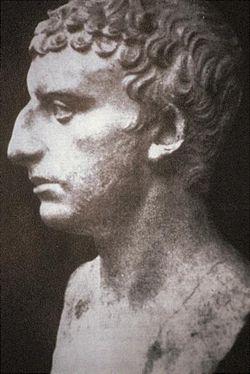
Titus Flavius Josephus (37 – c. A.D. 100),[2] also called Joseph ben Matityahu (Biblical Hebrew: יוסף בן מתתיהו, Yosef ben Matityahu),[3] was a 1st-century Romano-Jewish historian and hagiographer of priestly and royal ancestry who recorded Jewish history, with special emphasis on the 1st century AD and the First Jewish–Roman War which resulted in the Destruction of Jerusalem in 70 AD.
He has been credited by many as recording some of the earliest history of Jesus Christ outside of the gospels,[4] this being an item of contention among historians.