Rainier Tower is a 31-storey 156.67 m (514.0 ft) skyscraper in the Metropolitan Tract of Seattle, Washington, at 1301 Fifth Avenue. It was designed by Minoru Yamasaki, who designed the World Trade Center in New York City as well as the IBM Building, which is on the corner across the street from Rainier Tower to the southeast. Its construction was completed in 1977.[4]
Alternative names Rainier BankSecurity Pacific Bank
Rainier Square
The skyscraper has an unusual appearance, being built atop an 11-storey, 37 m (121 ft) concrete pedestal base that tapers towards ground level, like an inverted pyramid.
Beneath the tower is Rainier Square, an underground shopping mall. Both the mall and tower were originally named after Rainier Bank, which was merged in the 1980s into Security Pacific, which was eventually merged into BankAmerica.[5]

ATM
An Automated Teller Machine (ATM), also known as a Cash Point (which is a trademark of Lloyds TSB), Cash Machine or sometimes a Hole in the Wall in British English, is a computerised telecommunications device that provides the clients of a financial institution with access to financial transactions in a public space without the need for a cashier, human clerk or bank teller. ATMs are known by various other names including ATM Machine, automatic banking machine, and various regional variants derived from trademarks on ATM systems held by particular banks.
Invented by IBM, the first ATM was introduced in December 1972 at Lloyds Bank in the UK. However, there is a plaque on Barclays Bank in Enfield Town, north London stating that the first ATM (in the world) was installed there on the 27th June 1967. On most modern ATMs, the customer is identified by inserting a plastic ATM card with a magnetic stripe or a plastic smart card with a chip, that contains a unique card number and some security information such as an expiration date or CVVC (CVV). Authentication is provided by the customer entering a personal identification number (PIN).
Rainier Bancorp was the Seattle-based parent corporation of Rainier National Bank, a Washington state-based bank with branches throughout the state. Rainier traced its roots back to the National Bank of Commerce, which was founded by Richard Holyoke in 1889. [1] The name Rainier National Bank was adopted in 1974. Rainier Bancorp. expanded into Alaska with the purchase of People's Bank & Trust in 1983 [2] and into Oregon in 1986, expanding further in Oregon in 1987 with the government assisted purchase of Lincoln S&L Assoc. After a brief bidding war with First Bank System, Rainier Bancorp. was acquired by Security Pacific Corp. in 1987. At the time of its acquisition, it was the second largest bank in the state.[3]
In 1992 Security Pacific Bank merged with San Francisco-based BankAmerica (now called Bank of America), a deal that was at the time one of the largest bank mergers in history. Federal regulators, however, forced the divestiture of over half of the former Rainier Bank Washington state franchise (having been renamed Security Pacific Bank Washington, N.A. in 1989), as the combination of BankAmerica's Seafirst subsidiary and Rainier would have given BankAmerica too large a share of the retail banking market in Washington state. While 82 branches were retained and consolidated with Seafirst, 38 were sold to West One Bancorp (now itself merged into U.S. Bancorp) and 48 to KeyBank.[4]
Asynchronous Transfer Mode (ATM)
Asynchronous Transfer Mode (ATM) is a standard switching technique designed to unify telecommunication and computer networks. It uses asynchronous time-division multiplexing,[1][2] and it encodes data into small, fixed-sized cells. This differs from approaches such as the Internet Protocol or Ethernet that use variable sized packets or frames. ATM provides data link layer services that run over a wide range of OSI physical Layer links. ATM has functional similarity with both circuit switched networking and small packet switched networking. It was designed for a network that must handle both traditional high-throughput data traffic (e.g., file transfers), and real-time, low-latency content such as voice and video. ATM uses a connection-oriented model in which a virtual circuit must be established between two endpoints before the actual data exchange begins.[2] ATM is a core protocol used over the SONET/SDH backbone of the public switched telephone network (PSTN) and Integrated Services Digital Network (ISDN), but its use is declining in favor of All IP.
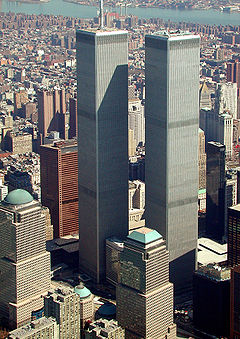
Minoru Yamasaki (山崎 實 Yamasaki Minoru?, December 1, 1912 – February 7, 1986) was an American architect, best known for his design of the twin towers of the World Trade Center, buildings 1 and 2. [1] Yamasaki was one of the most prominent architects of the 20th century. He and fellow architect Edward Durell Stone are generally considered to be the two master practitioners of "New Formalism."[2]
Lloyds TSB Bank Plc is a retail bank in the United Kingdom. It was established in 1995 by the merger of Lloyds Bank, established in Birmingham, England in 1765 and traditionally considered one of the Big Four clearing banks, with the TSB Group which traces its origins to 1810.[1] Lloyds TSB has an extensive network of branches and cash machines across England and Wales and offers 24-hour telephone and online banking services. Today it has 16 million personal customers and small business accounts.[2] In Scotland, the bank operates as Lloyds TSB Scotland Plc.
Following the acquisition of HBOS in 2008, the parent Lloyds TSB Group was renamed Lloyds Banking Group.[3] In 2009, following the liquidity crisis, HM Government took a 43.4% stake in Lloyds Banking Group and it was subsequently announced that a standalone retail banking business of 600 branches, including the TSB brand, would be divested by the Group to comply with European Union state aid requirements.[4] As a consequence, Lloyds TSB Bank will be rebranded as Lloyds Bank by the end of 2013.[5]