
This detail from Salvator Mundi, an unfinished oil painting on wood, reveals Dürer's highly detailed preparatory drawing. See full painting


OK, you may not think this looks like me, but it is. One day I was in the public library in Te Puke and the librarian were trying to find a picture of Durer for me. When we found the self portrait opposite, (right) she said something like "Doesn't he look fantastic"? There is no answer to that. The first thing I felt like saying was something stupid like, "Well why don't you take a closer look at me?"
This story goes back to the year 1500, before I was born, when I was working away on my /Gods, studio away in another world. It was important to get the timing right. Most of the work had been done in the year 1499. The other works that year included the one below.
Portrait of Oswolt Krel, a merchant from Lindau (Lake Constance), participating in the South German medieval trade corporation Große Ravensburger Handelsgesellschaft, 1499.

It was important that it be finished as late as possible in the year 1499 so that it could have the date 1500 on it, and it was. Much has been saidelsewhere about the art fraud business, and the standard "make two copies" attitude, and from each presumably another two copies. Who knew that this was going on, or that copying an original portrait without permission was illegal?
The other thing about this story is that since most of the works I don't remember doing, and these were done on earth, at the time, then I must have done them in a previous lifetime. This is something most people, physacists included, would think is not possible, but I assure you, that even if I am the only exception, it is. Why the 1500 portrait was not done at this time I can only speculate, but I presume I was not present at that time,and that opens the question of who Mrs Durer was, and what did she know?
For more about this I suggest Cezanne
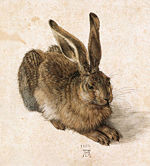
Young Hare, 1502, Watercolour and bodycolour (Albertina, Vienna).
Albrecht Dürer (German pronunciation: [ˈalbʁɛçt ˈdyːʁɐ]; 21 May 1471 – 6 April 1528)[1] was a German painter, printmaker, engraver, mathematician, and theorist from Nuremberg. His prints established his reputation across Europe when he was still in his twenties, and he has been conventionally regarded as the greatest artist of the Northern Renaissance ever since. His vast body of work includes altarpieces and religious works, numerous portraits and self-portraits, and copper engravings. His woodcuts, such as the Apocalypse series (1498), retain a more Gothic flavour than the rest of his work. His well-known works include the Knight, Death, and the Devil (1513), Saint Jerome in his Study (1514) and Melencolia I (1514), which has been the subject of extensive analysis and interpretation. His watercolours mark him as one of the first European landscape artists, while his ambitious woodcuts revolutionized the potential of that medium.
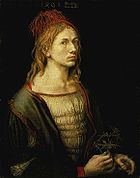
Dürer's introduction of classical motifs into Northern art, through his knowledge of Italian artists and German humanists, has secured his reputation as one of the most important figures of the Northern Renaissance. This is reinforced by his theoretical treatises, which involve principles of mathematics, perspective and ideal proportions.
Return to Nuremberg (1495–1505)
On his return to Nuremberg in 1495, Dürer opened his own workshop (being married was a requirement for this). Over the next five years his style increasingly integrated Italian influences into underlying Northern forms. Dürer's father died in 1502, and his mother died soon after in 1513.[7] His best works in the first years of the workshop were his woodcut prints, mostly religious, but including secular scenes such as The Men's Bath House (ca. 1496). These were larger than the great majority of German woodcuts hitherto, and far more complex and balanced in composition.
It is now thought unlikely that Dürer cut any of the woodblocks himself; this task would have been performed by a specialist craftsman. However, his training in Wolgemut's studio, which made many carved and painted altarpieces and both designed and cut woodblocks for woodcut, evidently gave him great understanding of what the technique could be made to produce, and how to work with block cutters. Dürer either drew his design directly onto the woodblock itself, or glued a paper drawing to the block. Either way, his drawings were destroyed during the cutting of the block.

St. Michael Fighting the Dragon by Albrecht Durer
His famous series of sixteen great designs for the Apocalypse[8] are dated 1498, as is his engraving of St. Michael Fighting the Dragon. He made the first seven scenes of the Great Passion in the same year, and a little later, a series of eleven on the Holy Family and saints. The Seven Sorrows Polyptych, commissioned by Frederick III of Saxony in 1496, was executed by Dürer and his assistants c. 1500. Around 1503–1505 he produced the first seventeen of a set illustrating the Life of the Virgin, which he did not finish for some years. Neither these, nor the Great Passion, were published as sets until several years later, but prints were sold individually in considerable numbers.[3]

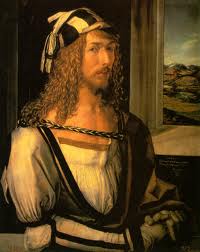
Self-Portrait (1500) by Albrecht Dürer
Self-Portrait (earlier known as Self-Portrait at Twenty-Eight Years Old Wearing a Coat with Fur Collar[1] or Self-Portrait in a Wig[2]) is a painting on wood panel by the German Renaissance artist Albrecht Dürer. Painted early in 1500, just before his 29th birthday, it is the last of his three painted self-portraits. It is considered the most personal, iconic and complex of his self-portraits, and the one that has become fixed in the popular imagination.[3]
The self-portrait is most remarkable because of its arrogant suggestion of divinity in its resemblance to many earlier representations of Christ. Art historians note the similarities with the conventions of religious painting, including its symmetry, dark tones and the manner in which the artist directly confronts the viewer and raises his hands to the middle of his chest as if in the act of blessing. It is likely that Dürer portrayed himself in this way through a combination of arrogance and a desire by a young and ambitious artist to acknowledge that his talent as God given.

Adam & Eve (1507).
Despite the regard in which he was held by the Venetians, Dürer returned to Nuremberg by mid-1507, remaining in Germany until 1520. His reputation had spread throughout Europe and he was on friendly terms and in communication with most of the major artists including Raphael, Giovanni Bellini and — mainly through Lorenzo di Credi — Leonardo da Vinci.
Between 1507 and 1511 Dürer worked on some of his most celebrated paintings: Adam and Eve (1507), The Martyrdom of the Ten Thousand (1508, for Frederick of Saxony), Virgin with the Iris (1508), the altarpiece Assumption of the Virgin (1509, for Jacob Heller of Frankfurt), and Adoration of the Trinity (1511, for Matthaeus Landauer). During this period he also completed two woodcut series, the Great Passion and the Life of the Virgin, both published in 1511 together with a second edition of the Apocalypse series. The post-Venetian woodcuts show Dürer's development of chiaroscuro modelling effects,[9] creating a mid-tone throughout the print to which the highlights and shadows can be contrasted.

