On 24 January, 41, Caligula was assassinated in a broad-based conspiracy involving the Praetorian commander Cassius Chaerea and several Senators. There is no evidence that Claudius had a direct hand in the assassination, although it has been argued that he knew about the plot — particularly since he left the scene of the crime shortly before his nephew was murdered.[8] However, after the deaths of Caligula's wife and daughter, it became apparent that Cassius intended to go beyond the terms of the conspiracy and wipe out the imperial family. In the chaos following the murder, Claudius witnessed the German guard cut down several uninvolved noblemen, including many of his friends. He fled to the palace to hide. According to tradition, a Praetorian named Gratus found him hiding behind a curtain and suddenly declared him princeps.[9] A section of the guard may have planned in advance to seek out Claudius, perhaps with his approval. They reassured him that they were not one of the battalions looking for revenge. He was spirited away to the Praetorian camp and put under their protection.

Coin of Herod of Chalcis, showing Herod of Chalcis with brother Agrippa of Judaea crowning Roman Emperor Claudius I. British Museum.

The Senate quickly met and began debating a change of government, but this eventually devolved into an argument over which of them would be the new Princeps. When they heard of the Praetorians' claim, they demanded that Claudius be delivered to them for approval, but he refused, sensing the danger that would come with complying. Some historians, particularly Josephus,[10] claim that Claudius was directed in his actions by the Judean King Herod Agrippa. However, an earlier version of events by the same ancient author downplays Agrippa's role[11] — so it is not known how large a hand he had in things. Eventually the Senate was forced to give in and, in return, Claudius pardoned nearly all the assassins.
I'm not certain these facts are correct. Claudius ( 10 BC- 43 ) had a sister      ((Claudia) Livia Julia   Livilla (the "little Livia").(13 BC-  31AD) who had a daughter Julia (5 -43  ) who married Nero.


If the birth and death dates of Claudius are accurate, he died in 43 AD, aged 53, but his sister died in 31 AD. aged 44.  If she had outlived him, by one year, she still would have only been (at least) 56.

Julia maried Nero, not Nero who beame Emperor. She died 43, aged 38, but if she had outlived Claudius, she would have been at least 39.

Nero who succeeded Claudius in 54 was born in 37 and died in 68, aged 31.

I'm presuming that the years he was emperor (54-68) are the best historical dates.

if Nero succeeded Claudius, Claudius either died in 54, not 43, or there was a long gap between his death Nero's succession.


If he died in 54 he would have been 64 years old, and if his sister outlived him, she would have been 67, her daughter, 49 in 54AD.


Claudius (Latin: Tiberius Claudius Caesar Augustus Germanicus;[1] 1 August 10 BC – 13 October 54), was Roman Emperor from 41 to 54. A member of the Julio-Claudian dynasty, he was the son of Drusus and Antonia Minor. He was born at Lugdunum in Gaul and was the first emperor to be born outside Italy. Afflicted with a limp and slight deafness due to sickness at a young age, his family ostracized him and excluded him from public office until his consulship with his nephew Caligula in 37. Claudius' infirmity probably saved him from the fate of many other nobles during the purges of Tiberius and Caligula's reigns; potential enemies did not see him as a serious threat. His survival led to his being declared emperor by the Praetorian Guard after Caligula's assassination, at which point he was the last adult male of his family.

Despite his lack of experience, Claudius proved to be an able and efficient administrator. He was also an ambitious builder, constructing many new roads, aqueducts, and canals across the empire. During his reign the empire conquered Thrace, Noricum, Pamphylia, Lycia and Judaea, and began the conquest of Britain. He took a personal interest in law, presided at public trials, and issued up to twenty edicts a day. However, he was seen as vulnerable throughout his reign, particularly by the nobility. Claudius was constantly forced to shore up his position; this resulted in the deaths of many senators. These events damaged his reputation among the ancient writers, though more recent historians have revised this opinion. After his death in 54, his grand-nephew and adopted son Nero succeeded him as emperor.


Livilla was married twice, first in 2 BC to Gaius Caesar, Augustus' grandson and potential successor. Thus, Augustus had chosen Livilla as the wife of the future Emperor. This splendid royal marriage probably gave Livilla grand aspirations for her future, perhaps at the expense of the ambition of Augustus' granddaughters, Agrippina the Elder and Julia the Younger. However, Gaius died in 4 AD, cutting short Augustus' and Livilla's plans.

In the same year, Livilla married her cousin Drusus Julius Caesar, the son of Tiberius. When Tiberius succeed Augustus as Emperor in 14 AD, Livilla again was the wife of a potential successor. Drusus and Livilla had three children, a daughter names Julia in 5 AD and twin brothers in 19 AD: of these Germanicus Gemellus died in 23, whereas Tiberius Gemellus survived his infancy.

Julia Drusi Caesaris Filia (Classical Latin: IVLIA•DRVSI•CAESARIS•FILIA,[1] 5-43) was the daughter of Julius Caesar Drusus and Livilla and granddaughter to the Roman Emperor Tiberius


At the time of Emperor Augustus' death in 14 Julia was ill. Augustus had asked his wife Livia, before he died whether she recovered.[2]

In 20, Julia married her cousin Nero Caesar (the son of Germanicus and Agrippina the Elder). The marriage appears to have been an unhappy one, and fell victim to the machinations of the notorious palace guardsman Sejanus, who exploited his intimacy with Livilla to scheme against Germanicus’ family. In the words of Tacitus,

"Whether the young prince spoke or held his tongue, silence and speech were alike criminal. Every night had its anxieties, for his sleepless hours, his dreams and sighs were all made known by his wife to her mother Livia [i.e. Livilla] and by Livia to Sejanus".[3]
In 20, Julia married her cousin Nero Caesar (the son of Germanicus and Agrippina the Elder). The marriage appears to have been an unhappy one, and fell victim to the machinations of the notorious palace guardsman Sejanus, who exploited his intimacy with Livilla to scheme against Germanicus’ family. In the words of Tacitus,


Nero Julius Caesar Germanicus (c. AD 6 –AD 30) was a close relative of the Roman Emperors of the Julio-Claudian dynasty.

Nero was born around AD 6, to Germanicus and Agrippina the Elder. His paternal grandparents were Nero Claudius Drusus and Antonia Minor, daughter of Mark Antony and Octavia Minor. His maternal grandparents were Marcus Vipsanius Agrippa and Julia the Elder, daughter of Caesar Augustus.

Nero's siblings included four brothers (Tiberius and Gaius Julius, who died young; Drusus Caesar; and the future Emperor Caligula) and three sisters (Agrippina the Younger, Julia Drusilla, and Julia Livilla). In 20, he married Julia (daughter of Drusus the Younger), daughter of Livilla and Drusus "Castor" (Tiberius' only son by Vipsania).

Nero was uncle to Julia Drusilla (daughter of Caligula) and through his sister Agrippina the Younger was uncle to the Emperor Nero (born Lucius Domitius Ahenobarbus). He was also a great-grandson of the Emperor Augustus, great-nephew and adoptive grandson of the Emperor Tiberius, and nephew of the Emperor Claudius.

Claudius was born on 1 August 10 BC in Lugdunum to Nero Claudius Drusus and Antonia on the day of the dedication of the altar to Augustus at the Sanctuary of the Three Gauls. He had two older siblings named Germanicus and Livilla. Antonia may have had two other children who died young. His maternal grandparents were Mark Antony and Octavia Minor, Augustus' sister, therefore the great-great grandnephew of Gaius Julius Caesar. His paternal grandparents were Livia, Augustus' third wife, and Tiberius Claudius Nero. During his reign, Claudius revived the rumor that his father Drusus was actually the illegitimate son of Augustus, to give the false appearance that Augustus was Claudius' paternal grandfather.
Chronology
Augustus 27 BC14 AD
Tiberius 14 AD37 AD
Caligula 37 AD41 AD
Claudius 41 AD54 AD
Nero 54 AD68 AD

(Claudia) Livia Julia (Classical Latin: LIVIA•IVLIA[1]) (c. 13 BC – 31 A.D.) was the only daughter of Nero Claudius Drusus and Antonia Minor and sister of the Roman Emperor Claudius and Germanicus. She was named after her grand-mother, Augustus' wife Livia Drusilla, and commonly known by her family nickname Livilla (the "little Livia").

She was twice married to the potential successor in the Julio-Claudian dynasty, first to Augustus' grandson Gaius Caesar (died 4 AD) and later to Tiberius' son Drusus (died 23 AD). Allegedly, she helped her lover Sejanus in poisoning her husband and died shortly after Sejanus fell from power in 31 AD.

Tacitus reports that Livilla was a remarkably beautiful woman, despite the fact she was rather ungainly as a child.[2] The Senatus Consultum de Cn. Pisone patre[3] indicates that she was held with the highest esteem by her uncle and father-in-law, Tiberius, and by her grandmother Livia Drusilla.[4]

According to Tacitus, she felt resentment and jealousy against her sister-in-law Agrippina the Elder, the wife of her brother Germanicus, to whom she was unfavourably compared.[5] Indeed, Agrippina fared much better in producing imperial heirs to the household (being the mother of the Emperor Caligula and Agrippina the Younger) and was much more popular. Suetonius reports that she despised her younger brother Claudius; having heard he would one day become Emperor, she deplored publicly such a fate for the Roman people.[6]

As most of the female members of the Julio-Claudian dynasty, she may also have been very ambitious, in particular for her male offspring.[7]


Hearing of the death of her children, Sejanus' former wife Apicata committed suicide. Before her death, she addressed a letter to Tiberius, accusing Sejanus and Livilla of having poisoned Drusus. Drusus' cupbearer Lygdus and Livilla's physician Eudemus were questioned and under torture confirmed Apicata's accusation.

Livilla died shortly afterwards, either being killed or by suicide. According to Cassius Dio, Tiberius handed Livilla over to her mother, Antonia Minor, who locked her up in a room and starved her to death.[8]

Early in 32, the Senate proposed "terrible decrees...against her very statues and memory".[9]

Posthumously, there were further allegations of adultery with her physician Eudemus[10] and with the senator and poet Mamercus Aemilius Scaurus.[11]

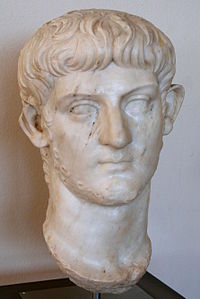
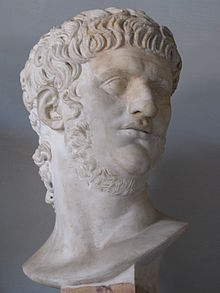
Nero (Latin: Nero Claudius Caesar Augustus Germanicus;[1] 15 December 37 – 9 June 68),[2] was Roman Emperor from 54 to 68, and the last in the Julio-Claudian dynasty. Nero was adopted by his great-uncle Claudius to become his heir and successor, and succeeded to the throne in 54 CE following Claudius' death.

During his reign, Nero focused much of his attention on diplomacy, trade, and enhancing the cultural life of the Empire. He ordered theaters built and promoted athletic games. During his reign, the redoubtable general Corbulo conducted a successful war and negotiated peace with the Parthian Empire. His general Suetonius Paulinus crushed a revolt in Britain. Also, he annexed the Bosporan Kingdom to the Empire, and the First Roman–Jewish War began.

In 64 CE, most of Rome was destroyed in the Great Fire of Rome, which many Romans believed Nero himself had started in order to clear land for his planned palatial complex, the Domus Aurea. In 68 CE, the rebellion of Vindex in Gaul and later the acclamation of Galba in Hispania drove Nero from the throne. Facing assassination, he committed suicide on 9 June 68 CE.[3]

Emperor

Early rule

Aureus of Nero and his mother, Agrippina, c. 54.

Claudius died in 54 and Nero, taking the name Nero Claudius Caesar Augustus Germanicus, was established as Emperor. Though accounts vary, many ancient historians state Agrippina poisoned Claudius.[13] According to Pliny the Elder, she used poison mushrooms.[23] It is not known how much Nero knew or was involved in the death of Claudius.[24]

Suetonius wrote "...for even if he was not the instigator of the emperor's death, he was at least privy to it, as he openly admitted; for he used afterwards to laud mushrooms, the vehicle in which the poison was administered to Claudius, as "the food of the gods," as the Greek proverb has it. At any rate, after Claudius's death he vented on him every kind of insult, in act and word, charging him now with folly and now with cruelty; for it was a favourite joke of his to say that Claudius had ceased "to play the fool among mortals, lengthening the first syllable of the word morari, and he disregarded many of his decrees and acts as the work of a madman and a dotard. Finally, he neglected to enclose the place where his body was burned except with a low and mean wall."[25]

Nero became Emperor at 17 when the news of Claudius' death was made known,[26][27] the youngest emperor until that time.[28] Ancient historians describe Nero's early reign as being strongly influenced by his mother Agrippina, his tutor Lucius Annaeus Seneca, and the Praetorian Prefect Sextus Afranius Burrus, especially in the first year.[29] Other tutors were less often mentioned, such as Alexander of Aegae.[30]


Make a free website with Yola