221B Baker Street is the London address of the fictional detective Sherlock Holmes, created by author Sir Arthur Conan Doyle.
In the United Kingdom, postal addresses with a number followed by a
letter may indicate a separate address within a larger, often
residential building. Baker Street in Holmes' time was a high-class residential district, and Holmes' apartment was probably part of a Georgian terrace.
At the time the Holmes stories were published, addresses in Baker
Street did not go as high as 221. Baker Street was later extended, and
in 1932 the Abbey National Building Society
moved into premises at 219–229 Baker Street. For many years, Abbey
National employed a full-time secretary to answer mail addressed to
Sherlock Holmes. In 1990, a blue plaque
signifying 221B Baker Street was installed at the Sherlock Holmes
Museum, situated elsewhere on the same block, and there followed a
15-year dispute between Abbey National and the Holmes Museum for the
right to receive mail addressed to 221B Baker Street. Since the closure
of Abbey House in 2005, ownership of the address by the Holmes Museum
has not been challenged, despite its location between 237 and 241 Baker
Street.
We met next day as he had arranged, and inspected the rooms at No.
221B, Baker Street, of which he had spoken at our meeting. They
consisted of a couple of comfortable bed-rooms and a single large airy
sitting-room, cheerfully furnished, and illuminated by two broad
windows.
(Arthur Conan Doyle, A Study in Scarlet, 1887)
When the "Sherlock Holmes" stories were first published, street
numbers in Baker Street only went up to 100, which was presumably why
Conan Doyle chose a higher street number for the location of his hero,
possibly to avoid problems with local residents who would have had to
fend off many strange visitors at unearthly hours seeking the detective
services of Mr. Holmes.[citation needed]
The section north of Marylebone Road near Regent's Park
— now including 221 Baker Street — was known in Conan Doyle's lifetime
as Upper Baker Street. In his first manuscript, Conan Doyle put Holmes'
house in "Upper Baker Street," indicating that if he had a house in
mind, it would have been there. However, a British crime novelist named
Nigel Morland claimed that, late in Conan Doyle's life, he identified
the intersection of Baker Street and George Street, about 500 metres
south of Marylebone Road, as the location of 221B. Sherlockian experts
have also held to alternative theories as to where the original 221B was
located and have maintained that it was further down Baker Street.[1]
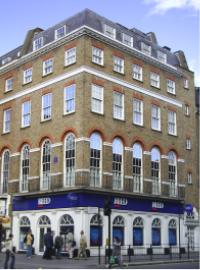
When street numbers were re-allocated in the 1930s, the block of odd numbers from 215 to 229 was assigned to an Art Deco
building known as Abbey House, constructed in 1932 for the Abbey Road
Building Society, which the society and its successor (which
subsequently became Abbey National plc) occupied until 2002.
Almost immediately, the building society started receiving
correspondence from Sherlock Holmes fans all over the world, in such
volumes that it appointed a permanent "secretary to Sherlock Holmes" to
deal with it. A bronze plaque on the front of Abbey House carried a
picture of Holmes and a quotation, but was removed from the building
several years ago. Its whereabouts is presently unknown. In 1999, Abbey
National sponsored the creation of a bronze statue of Sherlock Holmes
that now stands at the entrance to Baker Street tube station.
 listen) mar-li-bən) is an affluent inner-city area of central London, located within the City of Westminster. It is sometimes written as St. Marylebone or Mary-le-bone.